
Property note 5: helpful landscape guide for Tree-Work Scope
Tree trimming keeps trees structurally sound, safe, and well-shaped by removing dead, damaged, and crossing limbs and clearing growth away from roofs, drives, and overhead lines. In Albuquerque, where trees grow under intense high-altitude sun in alkaline soil and are exposed to spring winds and monsoon storms, sound pruning is what keeps a mature canopy standing.
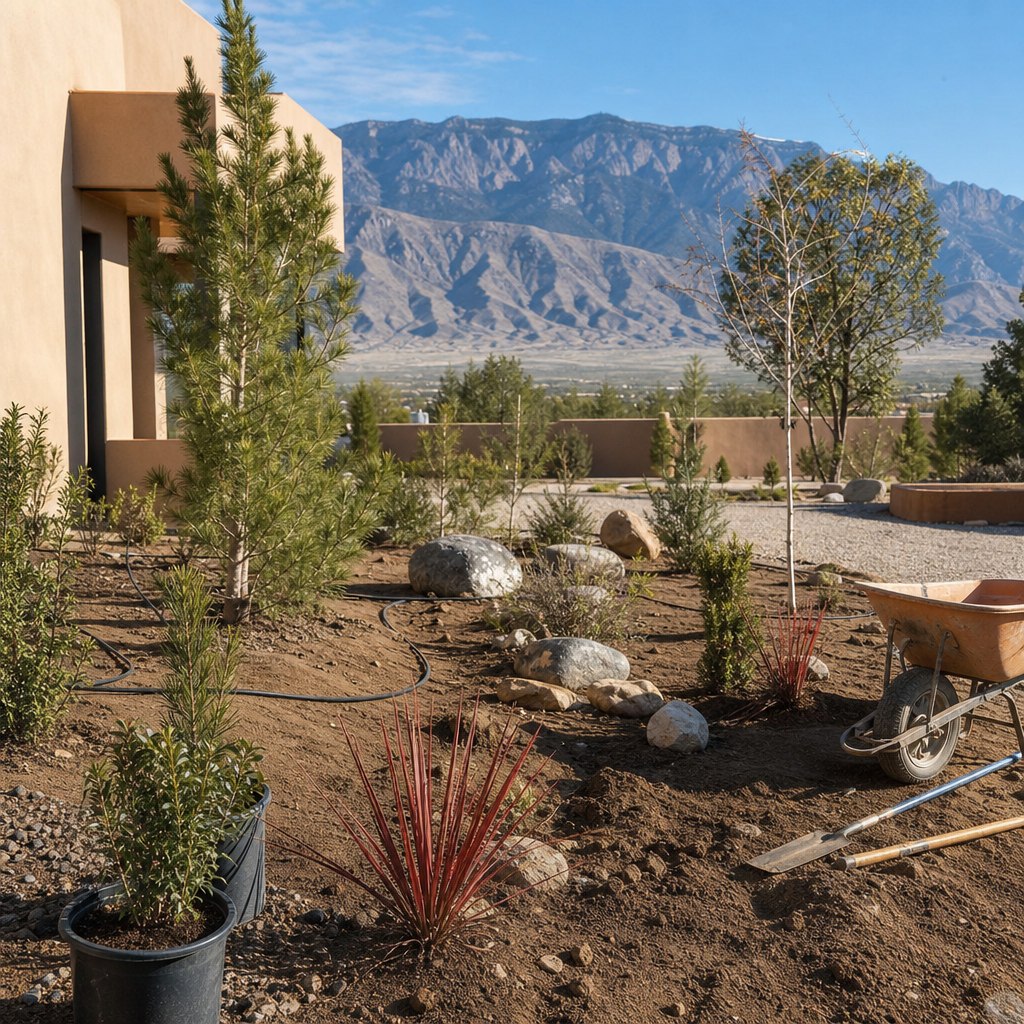
Property note 6: helpful landscape guide for Tree-Work Scope
Shade is the most valuable thing a high-desert yard can hold. A mature canopy lowers the surface temperature of everything beneath it, cuts the cooling load on the house, and reduces the water demand of the plants growing in its shadow. It also takes many years to establish here and cannot be replaced quickly.
Local conditions apply specific stresses. Spring winds work on every weak union and overextended limb. Monsoon storms arrive with sudden gusts, often onto ground freshly saturated by intense rain — maximum wind against minimum root anchorage. Intense sun at altitude can scald exposed bark on limbs that were previously shaded, which is one reason heavy thinning is a mistake here rather than a neutral choice.
Soil conditions matter as well. Where caliche layers sit close to the surface they restrict root penetration, and a tree that cannot root deeply is a tree less firmly anchored against wind. Alkaline soil, with New Mexico pH normally running between 6.5 and 8.4, also limits the availability of certain nutrients — which is why some trees here show stress that pruning alone will not resolve.
Property note 3: project details for Tree-Work Scope
Assessment. Record canopy clearance, irrigation reach, and the soil profile before specifying cuts. Albuquerque’s FY2026 city budget describes an arid climate with about nine inches of annual precipitation. NMSU Extension reports that New Mexico soils normally range from pH 6.5 to 8.4 and that caliche layers occur in many arid and semi-arid soils. Those are regional baselines, not a diagnosis for a particular root zone, so the written assessment should keep observed branch work, irrigation work, and any soil-testing follow-up as separate scope items. If spray irrigation is part of the follow-up, ABCWUA prohibits it from 11 a.m. to 7 p.m. between April 1 and October 31.
Remove photographed deadwood first, then evaluate Albuquerque clearance and canopy work.
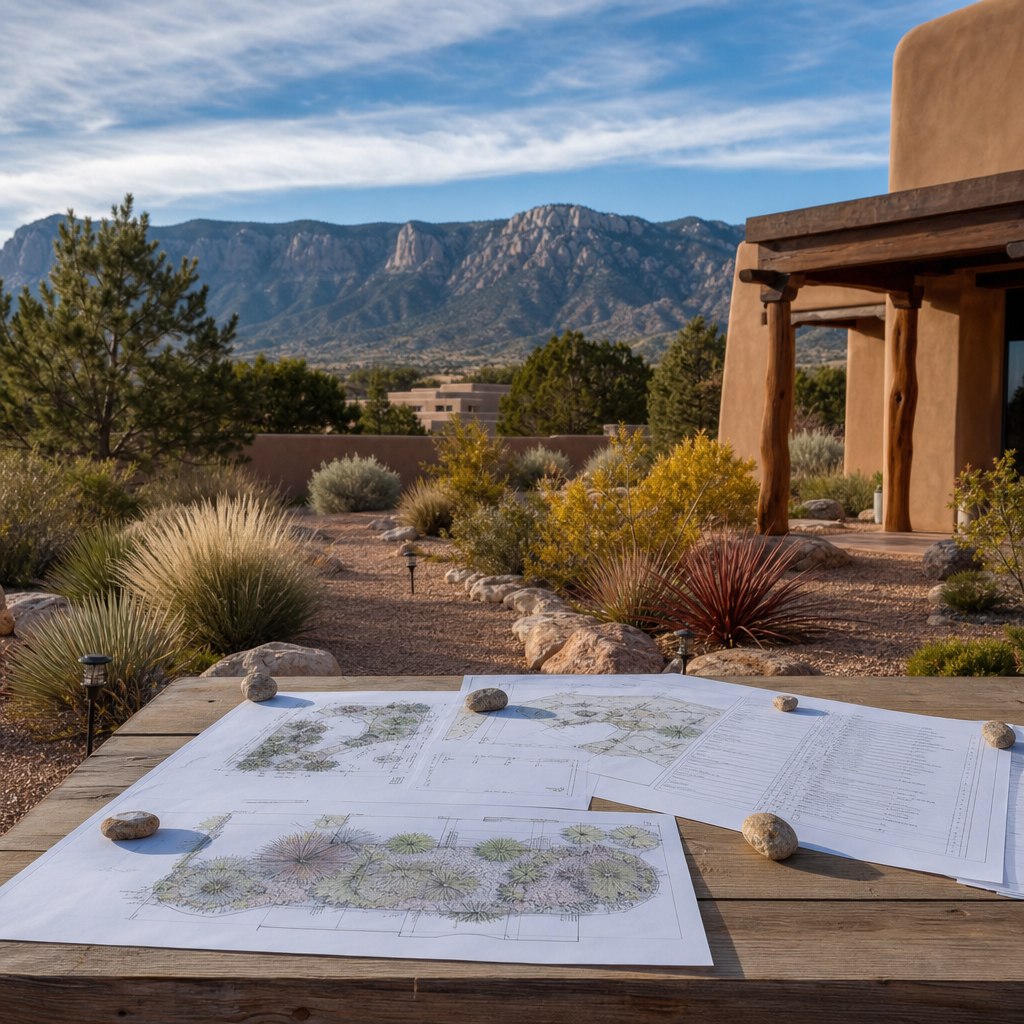
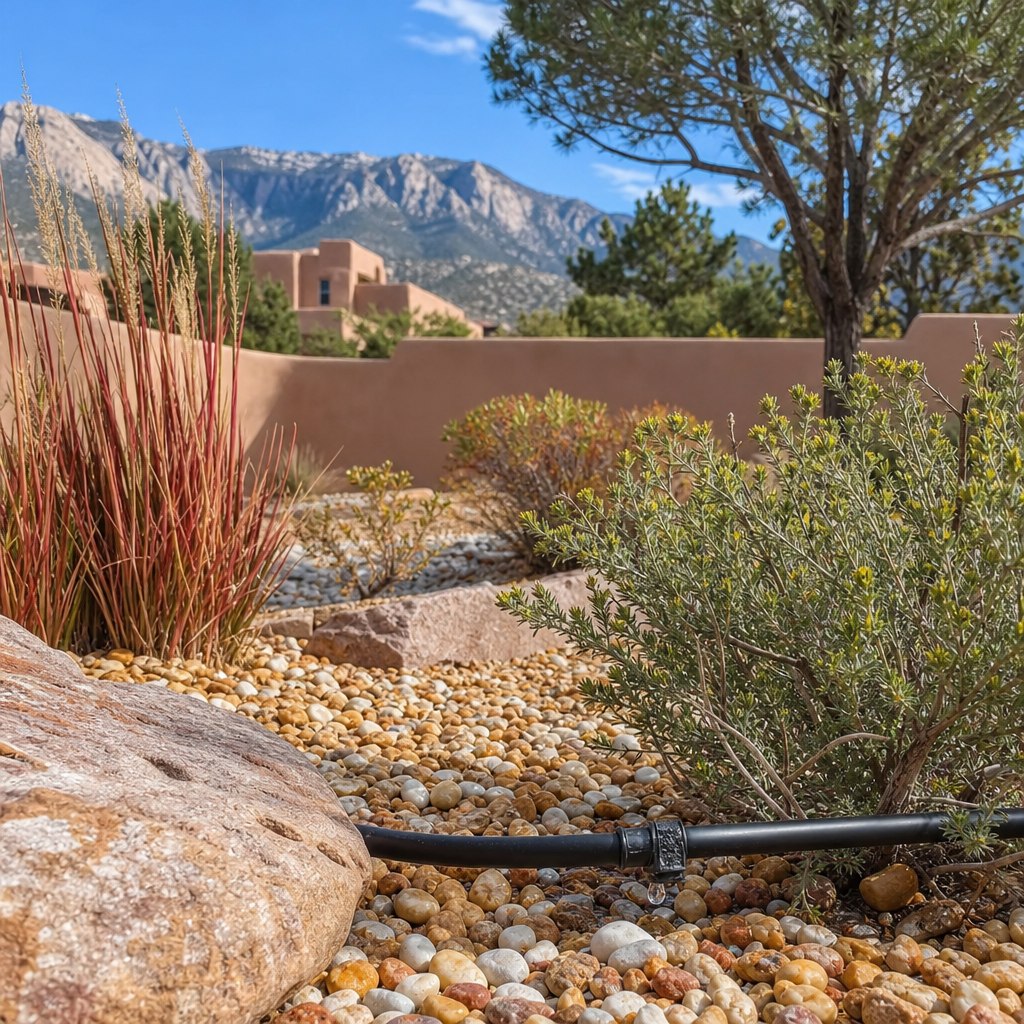
Structural correction. Crossing and rubbing limbs are removed before they wound one another; competing leaders and narrow, weakly attached unions are addressed while still small enough to address cheaply.
Selective thinning for wind. Thinning reduces the sail area a storm can push against. Done properly it is selective and restrained. Done as a blanket reduction it strips the leaf area the tree feeds on and exposes previously shaded bark to sun scald.
Clearance pruning. Branches are cleared from roofs, walls, drives, walkways, and overhead lines with future growth allowed for, so the clearance holds.
The Albuquerque pruning scope names debris removal and a final access-area check.
Property note 4: helpful landscape guide for Tree-Work Scope
A site review in Albuquerque should account for high-desert Rio Grande valley; alkaline sandy and caliche-prone soils can change irrigation, grading and plant establishment decisions. Document those conditions, confirm the applicable Bernalillo County and City of Albuquerque guidance, and select from locally workable vegetation such as xeric blue grama, yucca and desert willow for the property’s exposure.
Topping — cutting main limbs back to stubs for height control — is worth naming because it remains common and is genuinely harmful. It removes the foliage the tree lives on, forces dense weakly attached regrowth, and leaves wounds the tree cannot close. That regrowth is precisely what fails in the next wind event, and the sudden exposure of previously shaded bark invites sun damage on top. Height concerns are properly handled by selective reduction to suitable lateral branches.
Property note 1: Budget Inputs for Tree-Work Scope
Cost depends on the number and size of the trees, their height, the amount of deadwood and structural work required, and access. Access is often the largest single factor: a tree standing clear in an open yard is straightforward, while the same tree behind a narrow gate or above a roof, a wall, or a parked vehicle must be rigged down piece by piece under control. Debris volume and haul-away also count. We assess and quote on site, since two identical trees in different positions are very different jobs.
Timeline
Most residential jobs are completed in a single visit. Larger properties, several mature trees, or work requiring careful rigging over structures take longer. Clean-up and debris haul-away are included in the quoted work.
Property note 2: Timing Choices for Tree-Work Scope
The most valuable timing is before the seasons that test trees rather than after them — structural work ahead of spring winds and monsoon storms is preventive, while post-storm work can only clear up damage. Dead, damaged, and hazardous limbs are removed whenever found. Heavier structural pruning is generally best during dormancy, when the framework is clearly visible and the tree is least stressed. Book a visit when you can see deadwood, crossing limbs, long overextended branches, growth over a roof or drive, branches approaching overhead lines, or a canopy that has simply become dense.
Local note: watering trees under the ABCWUA rules
Trees need deep, infrequent watering to stay healthy and well anchored, and Albuquerque’s rules shape how that is delivered. From April 1 through October 31 the Albuquerque Bernalillo County Water Utility Authority prohibits spray irrigation between 11 a.m. and 7 p.m., but drip irrigation, low-precipitation bubblers, and hand watering are exempt from that restriction. Bubblers are particularly well suited to trees, delivering a useful volume into a basin at the root zone. Deep watering out at the drip line, where the feeder roots are, produces a better-anchored and more wind-resistant tree than frequent shallow watering at the trunk — and because bubblers are exempt, that watering can be done without working around the daytime restriction. Where caliche limits rooting depth, getting the watering right matters even more. (Source: Albuquerque Bernalillo County Water Utility Authority.)
Frequently asked questions
When is the best time to trim trees in Albuquerque? Structural and wind-reduction work is best done ahead of spring winds and monsoon season. Dead, damaged, or hazardous limbs are removed at any time, and heavier structural pruning is often best during dormancy.
Can pruning make an Albuquerque tree wind-proof? No pruning scope should promise that result. Request an evaluation of visible defects, proposed cuts, retained canopy, work limits, and conditions that call for a qualified tree-risk assessment.
Can I water my trees during the day? With drip, low-precipitation bubblers, or a hand-held hose, yes — those methods are exempt from the 11 a.m. to 7 p.m. restriction that applies to spray irrigation.
Albuquerque debris scope. Put disposal terms in writing before pruning begins: identify material that remains for mulch or firewood, debris that leaves the property, the approved staging area, access limits, and any separate hauling charge. The closeout should match that documented choice instead of assuming removal is bundled.
Albuquerque roof-clearance planning. Photograph each branch-to-structure conflict, mark the requested clearance, and identify fragile surfaces or access limits in the written estimate. Treat any overhead-line proximity as a separate safety condition requiring the appropriate utility or qualified line-clearance provider, not as an automatic part of ordinary pruning.
My tree looks unwell even though I water it. What else could it be? Alkaline soil is a frequent factor here, since New Mexico soil pH normally runs between 6.5 and 8.4 and that restricts uptake of certain nutrients. Restricted rooting depth over caliche is another common contributor.
Sources
Albuquerque Bernalillo County Water Utility Authority — irrigation rules: abcwua.org. New Mexico State University Extension — New Mexico soil pH (Guide A-146) and caliche soils (Guide A-151): pubs.nmsu.edu.
Request a tree-risk review with Albuquerque site evidence
Get a Free Quote
Add the Albuquerque site conditions and the result you want reviewed.
Put the Albuquerque Site Conditions in Writing
Send the measured area, irrigation notes, access limits, and desired result so the proposed high-desert work can be scoped in writing.
Get a Free QuoteFrequently Asked Questions
What should be mapped before tree-pruning scope begins in Albuquerque?
Start with the actual work area: mark irrigation coverage, drainage paths, sun exposure, access limits and any hard ground encountered on site. That field map keeps the tree-pruning scope scope tied to this property instead of a neighborhood assumption.
How should the Project Plan record Albuquerque tree-pruning scope decisions?
The scope should name the measured areas, preparation method, selected materials, water-zone changes, cleanup responsibility and exclusions. Any soil or irrigation condition that has not been inspected should remain an open item rather than being priced as a certainty.
Which site finding can change an Albuquerque tree-pruning scope plan?
A buried hard layer, uneven irrigation coverage or an unexpected drainage route can change preparation and sequencing. The property walk should identify which finding controls the next decision before materials or dates are committed.