High Desert Landscaping in Albuquerque, NM
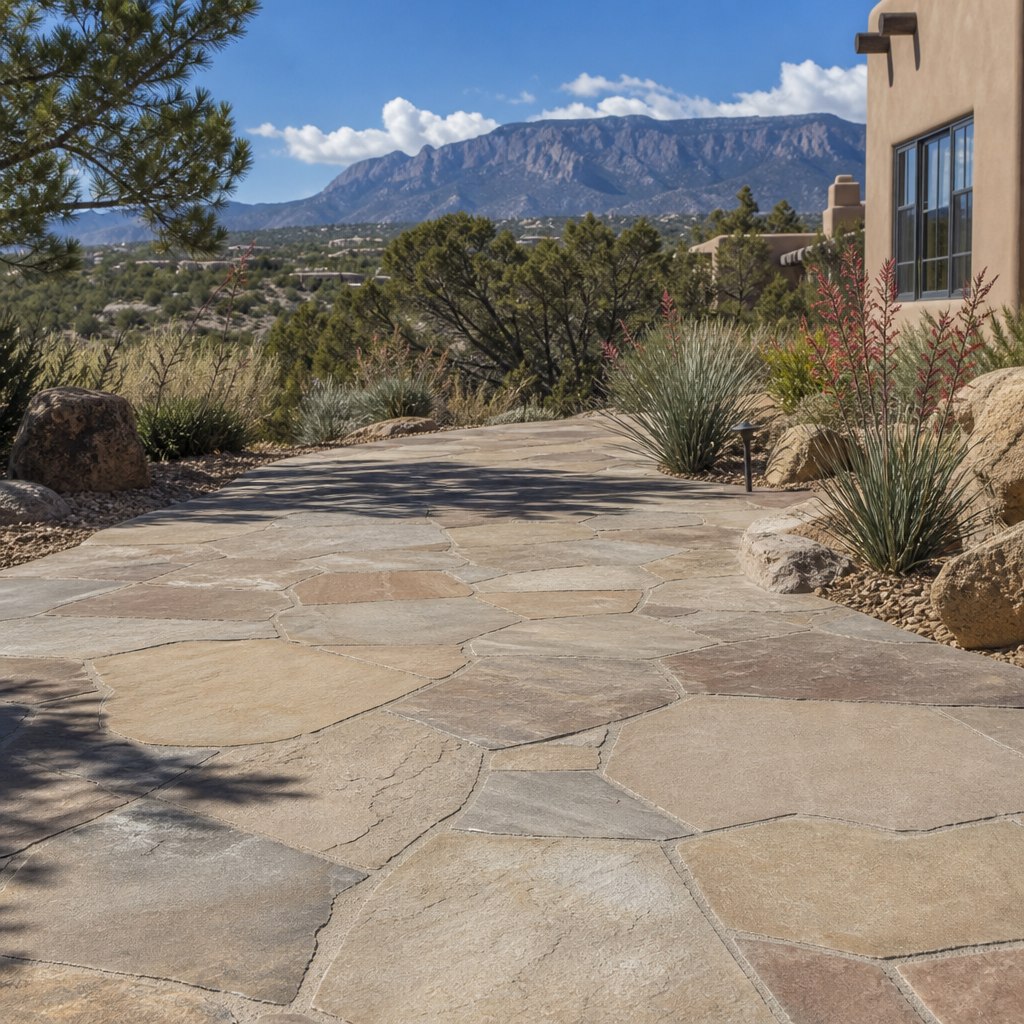
Desert landscaping replaces high-water turf with drought-adapted plants, permeable ground cover, and efficient irrigation matched to Albuquerque’s high-desert conditions. Done properly it accounts for what is actually beneath the surface here — alkaline soils and, on many properties, caliche — which is what separates a landscape that establishes from one that struggles for years.
Property note 5: helpful landscape guide for Neighborhood Property Planning
Albuquerque sits high, dry, and sunny, with wide day-to-night temperature swings and rainfall that arrives unevenly. A conventional lawn can be maintained here, but it is the thirstiest element on most properties and its heaviest demand falls in the months when the Water Utility Authority restricts spray irrigation between 11 a.m. and 7 p.m.
Soil is the other half of the argument, and it is the half most often skipped. New Mexico State University Extension guidance notes that soil pH in New Mexico normally falls between 6.5 and 8.4, with western soils typically alkaline, and that many arid and semi-arid New Mexico soils contain caliche layers beneath the surface, cemented by calcium and magnesium carbonates. Alkaline soil restricts the availability of certain nutrients to plants not adapted to it, and caliche physically obstructs both drainage and root penetration. Plants chosen for these conditions simply work; plants chosen from a catalogue written for somewhere else fight the ground for their whole lives.
Property note 4: helpful landscape guide for Neighborhood Property Planning
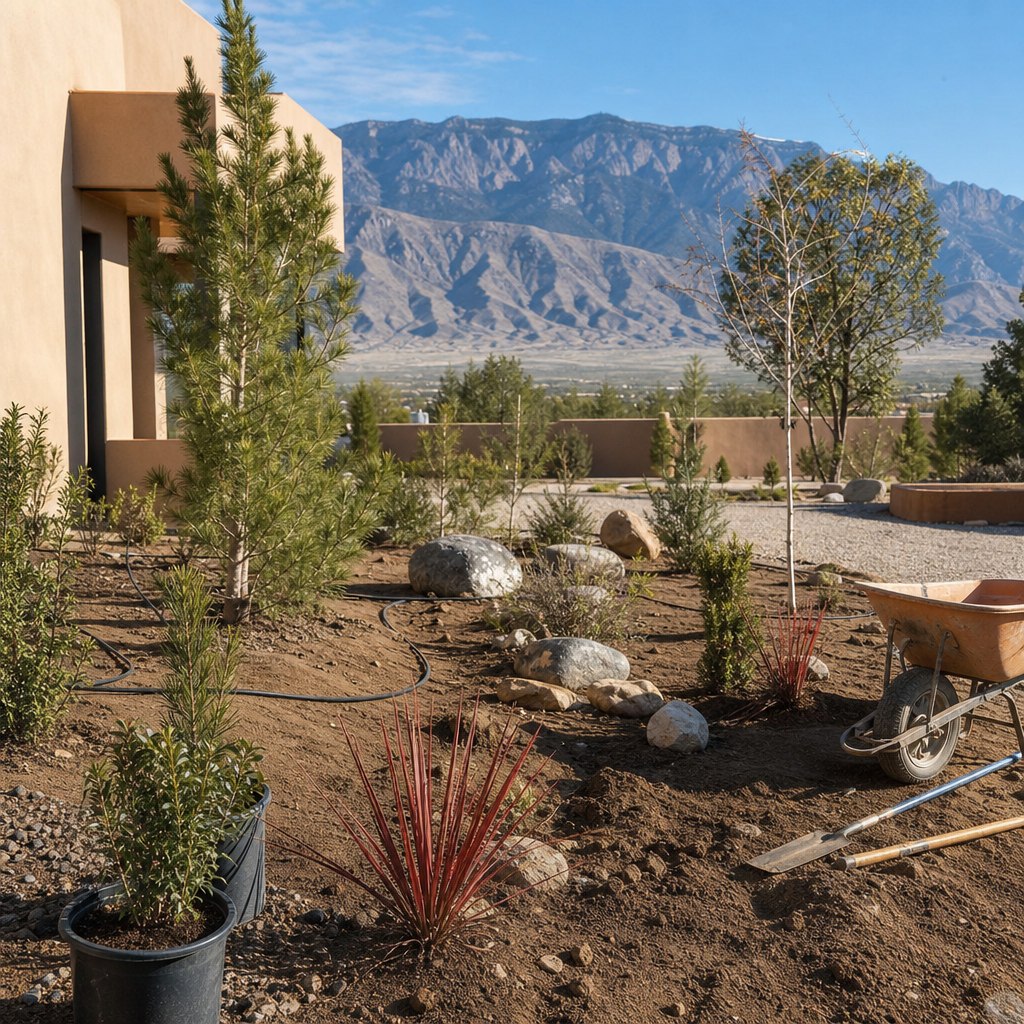
Removal and haul-off. Turf and root mass are removed rather than buried, since incomplete removal is why converted yards sprout grass through their gravel a season later.
Soil assessment and preparation. Where caliche sits close to the surface it must be identified and dealt with — broken through for planting pits, or planted around deliberately. A planting hole dug into caliche and backfilled without addressing it becomes a bucket that holds water against the roots.
Grading and drainage. High-desert rain arrives concentrated. Correct fall, shallow swales, and basins decide whether a storm waters the landscape or scours it toward the street.
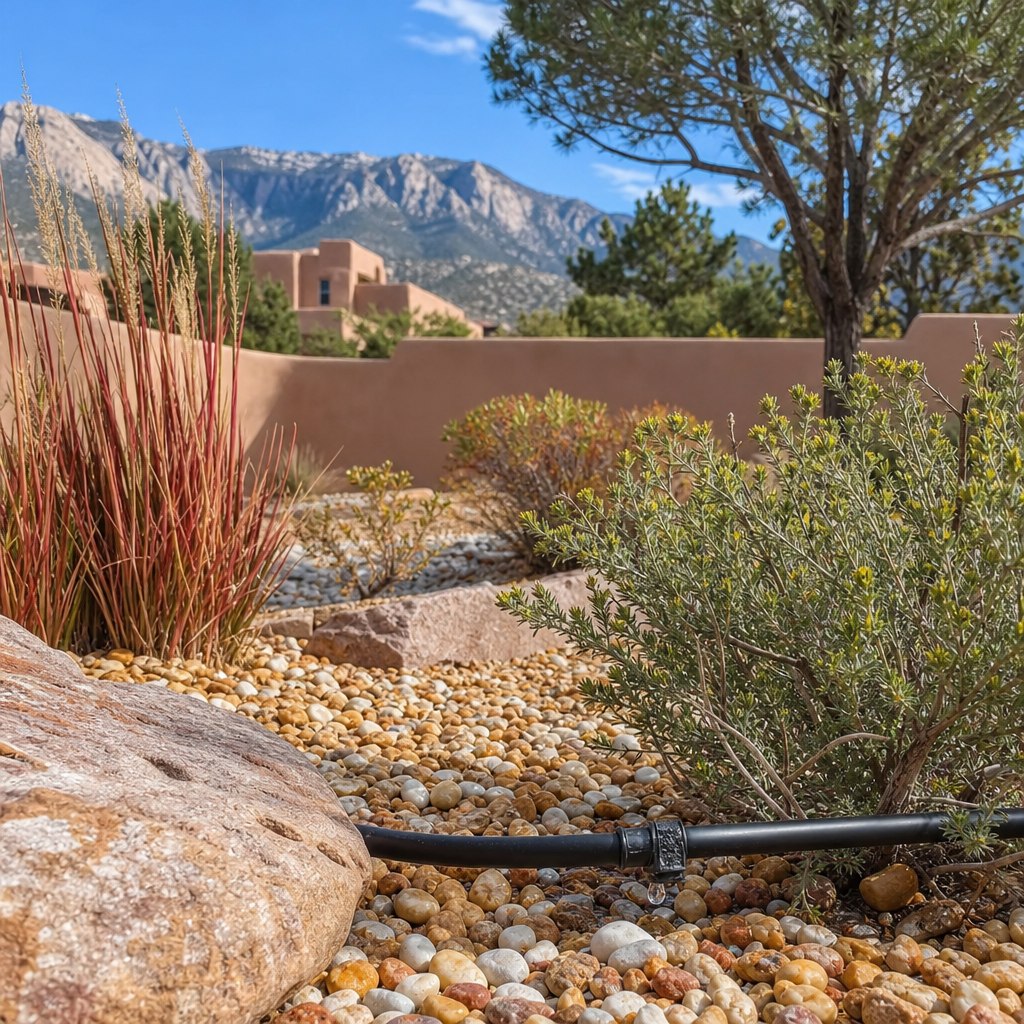
Irrigation. Spray heads come out; drip serves beds and low-precipitation bubblers serve trees and larger shrubs. Both are exempt from the daytime spray restriction.
Edging and ground cover. Edging holds boundaries between materials. Gravel or crusher fines are placed deep enough to genuinely suppress germination rather than merely cover soil.
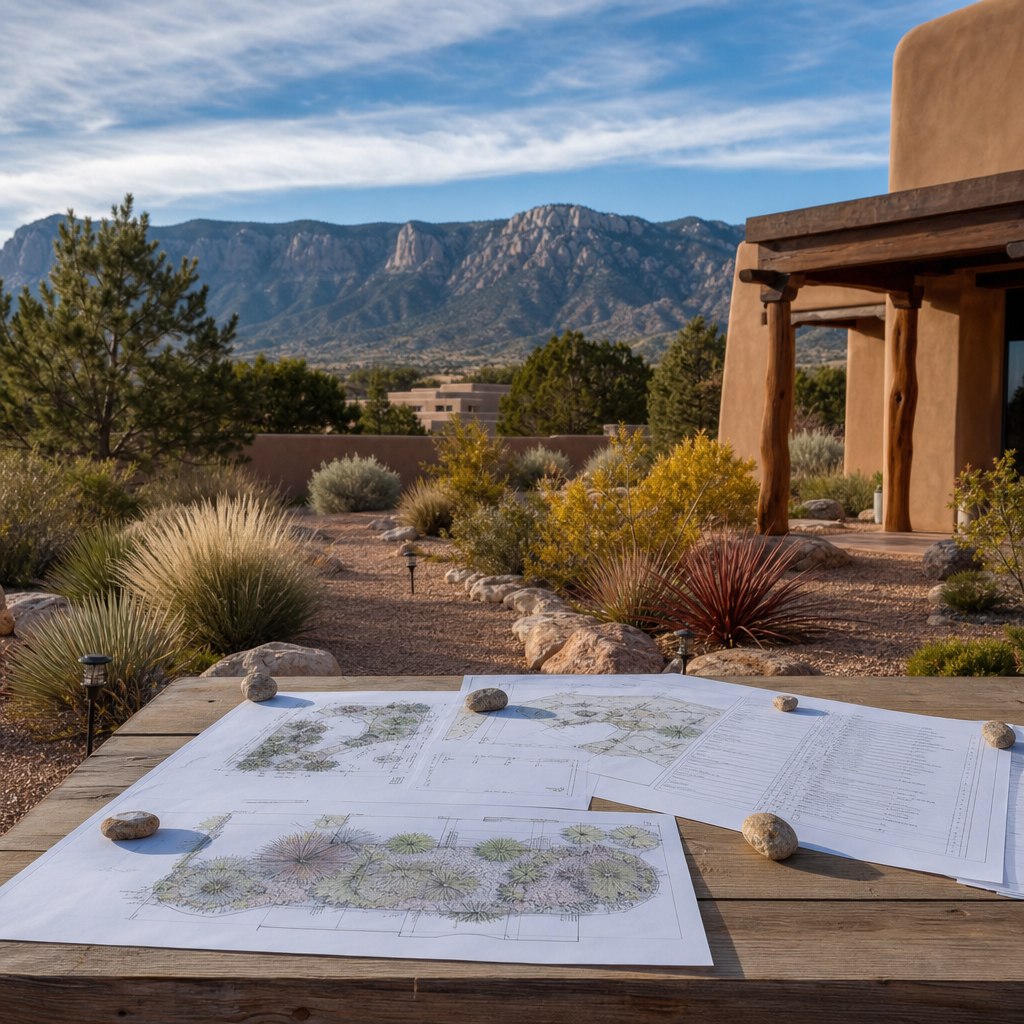
Albuquerque planting layout. Put each plant on the plan at its intended installed location, then record the nursery size, expected mature width, emitter assignment, and root-zone basin dimensions. Keep replacements and field adjustments on a marked revision so spacing and irrigation decisions remain tied to the actual yard rather than a generic plant count.
Design for the high desert
The strongest Albuquerque landscapes are layered rather than flat. Trees provide the canopy that makes a yard usable in June and reduces the water demand of everything beneath them. Structural shrubs carry the composition through the year, and accents, grasses, and perennials give seasonal colour and movement.
The version to avoid is a wide, unshaded expanse of gravel with a handful of plants in it. It stores and radiates heat toward the house, glares under high-altitude sun, and never reads as finished. The additional water needed to support real planting density is modest, and the difference in the result is considerable.
Property note 1: Budget Inputs for Neighborhood Property Planning
Cost depends on the area converted, how much turf and hardscape must be removed and hauled, how much grading and soil work the site needs, the plant and ground-cover selection, and the extent of the irrigation conversion. Caliche is a genuine cost driver where it is shallow, because breaking through it for planting pits is slow work. Access matters, since gravel is heavy and all of it has to reach the work area. Phasing a large conversion across seasons spreads both work and cost. We quote on site.
Timeline
Most residential conversions run from a few days to a couple of weeks depending on What’s included: removal and haul-off, grading and soil work, irrigation, edging and ground cover, then planting. Establishment follows — new plants need consistent water through their first full season, after which their requirement drops sharply and permanently.
Property note 2: helpful landscape guide for Neighborhood Property Planning
Desert landscaping is the right call if you want to cut irrigation water substantially, if areas of your yard have never really thrived, or if you would rather not schedule a lawn around a seven-month daytime watering restriction. If children or pets genuinely use a grass surface, a partial conversion is usually better: keep a modest, well-irrigated turf area and convert everything that exists only to be looked at.
Local constraint: the ABCWUA irrigation rule
From April 1 through October 31, the Albuquerque Bernalillo County Water Utility Authority prohibits spray irrigation between 11 a.m. and 7 p.m. Drip irrigation, low-precipitation bubblers, and hand watering are exempt from that restriction, and a 30-day exemption is available for establishing new sod. A converted landscape running on drip and bubblers sits outside the daytime restriction altogether, which is a practical benefit on top of the water saved. (Source: Albuquerque Bernalillo County Water Utility Authority.)
If you are keeping some lawn
Species choice is worth getting right. NMSU Extension guidance indicates that cool-season grasses can generally be used anywhere north of Socorro, and Albuquerque lies north of Socorro. The recommended cool-season species are perennial ryegrass, Kentucky bluegrass, and tall fescue, with tall fescue described as a good general-purpose turfgrass for New Mexico. Recommended warm-season species are bermudagrass, buffalograss, and zoysiagrass — though Extension guidance also notes that warm-season grasses go dormant and lose colour for at least five months of the year in New Mexico, which is the trade-off for their lower water use.
Property note 3: helpful landscape guide for Neighborhood Property Planning
A desert landscape needs attention, just much less of it. Ground cover is topped up where it thins or where a storm has moved it, weeds are pulled before they seed, shrubs and accents are pruned annually to hold form, and emitters are checked each season for clogs and breaks. Alkaline water encourages mineral build-up at emitters, so periodic flushing is worth doing here.
Frequently asked questions
Does a desert landscape still need irrigation? Yes, particularly through the first establishment season. Afterwards, adapted plants need only occasional deep watering — and on drip, that watering is exempt from the daytime restriction.
What is caliche and does it affect my yard? It is a subsurface layer cemented by calcium and magnesium carbonates, common in arid and semi-arid New Mexico soils. Where it is shallow it obstructs drainage and roots, and planting has to account for it rather than ignore it.
Why do some plants struggle here even when watered? Alkaline soil is a frequent reason. New Mexico soil pH normally runs between 6.5 and 8.4, and plants not adapted to that range take up certain nutrients poorly regardless of watering.
Can I keep part of my lawn? Yes, and it is often the best outcome. Concentrating irrigation on a small, genuinely used turf area captures most of the saving without losing the use.
Will the yard look bare? Only if it is under-planted. Layered trees, shrubs, grasses, and perennials give a high-desert landscape real year-round structure.
What happens to my spray system? In most conversions the heads come out and the system is reworked to drip and bubblers, which are more efficient and exempt from the daytime spray restriction.
Sources
Albuquerque Bernalillo County Water Utility Authority — irrigation rules: abcwua.org. New Mexico State University Extension — turfgrass selection (Guide H-508), New Mexico soil pH (Guide A-146), and caliche soils (Guide A-151): pubs.nmsu.edu.
Get a free quote for high desert landscaping in Albuquerque →
How much does landscaping cost in Albuquerque?
There is no single figure. Landscaping cost in Albuquerque depends on the area converted, how much turf and hardscape must be removed and hauled, how much grading and soil work the site needs, the plant and ground-cover selection, and the extent of the irrigation conversion. ABQ Landscape Co prices each of these per property.
Get a Free Quote
Add the Albuquerque site conditions and the result you want reviewed.
Put the Albuquerque Site Conditions in Writing
Send the measured area, irrigation notes, access limits, and desired result so the proposed high-desert work can be scoped in writing.
Get a Free QuoteFrequently Asked Questions
What should be mapped before neighborhood property planning begins in Albuquerque?
Start with the actual work area: mark irrigation coverage, drainage paths, sun exposure, access limits and any hard ground encountered on site. That field map keeps the neighborhood property planning scope tied to this property instead of a neighborhood assumption.
How should the Project Plan record Albuquerque neighborhood property planning decisions?
The scope should name the measured areas, preparation method, selected materials, water-zone changes, cleanup responsibility and exclusions. Any soil or irrigation condition that has not been inspected should remain an open item rather than being priced as a certainty.
Which site finding can change an Albuquerque neighborhood property planning plan?
A buried hard layer, uneven irrigation coverage or an unexpected drainage route can change preparation and sequencing. The property walk should identify which finding controls the next decision before materials or dates are committed.