ABQ Landscape Co is a local landscaping company serving homeowners across Albuquerque and Bernalillo County. Built for the high-desert climate – the heat, the soil, and the water rules set by Albuquerque Bernalillo County Water Utility Authority (ABCWUA). Work is completed by a local crew and every quote is free.
Local conditions set the choices here. New Mexico soils normally test between pH 6.5 and 8.4 and are typically alkaline, and many arid and semi-arid soils in the state carry cemented caliche layers beneath the surface — both shape which plants establish and how beds are prepared. Spray irrigation is restricted between 11 a.m. and 7 p.m. from 1 April to 31 October, while drip irrigation and low-precipitation bubblers stay available, which is why systems here are built around drip. Sources: NMSU Extension Guides A-146 and A-151; ABCWUA.
Study shade, irrigation reach, and the transition between planted and built areas in these Albuquerque project examples.
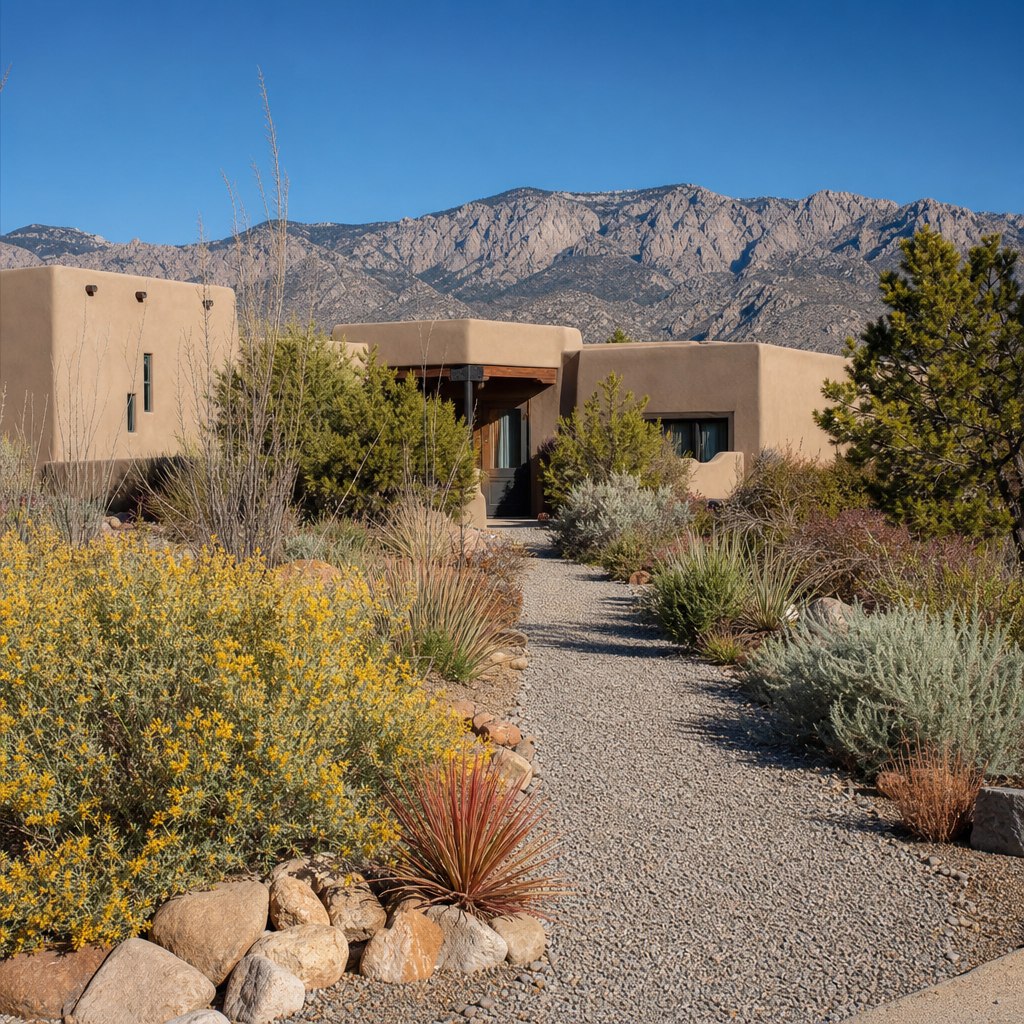
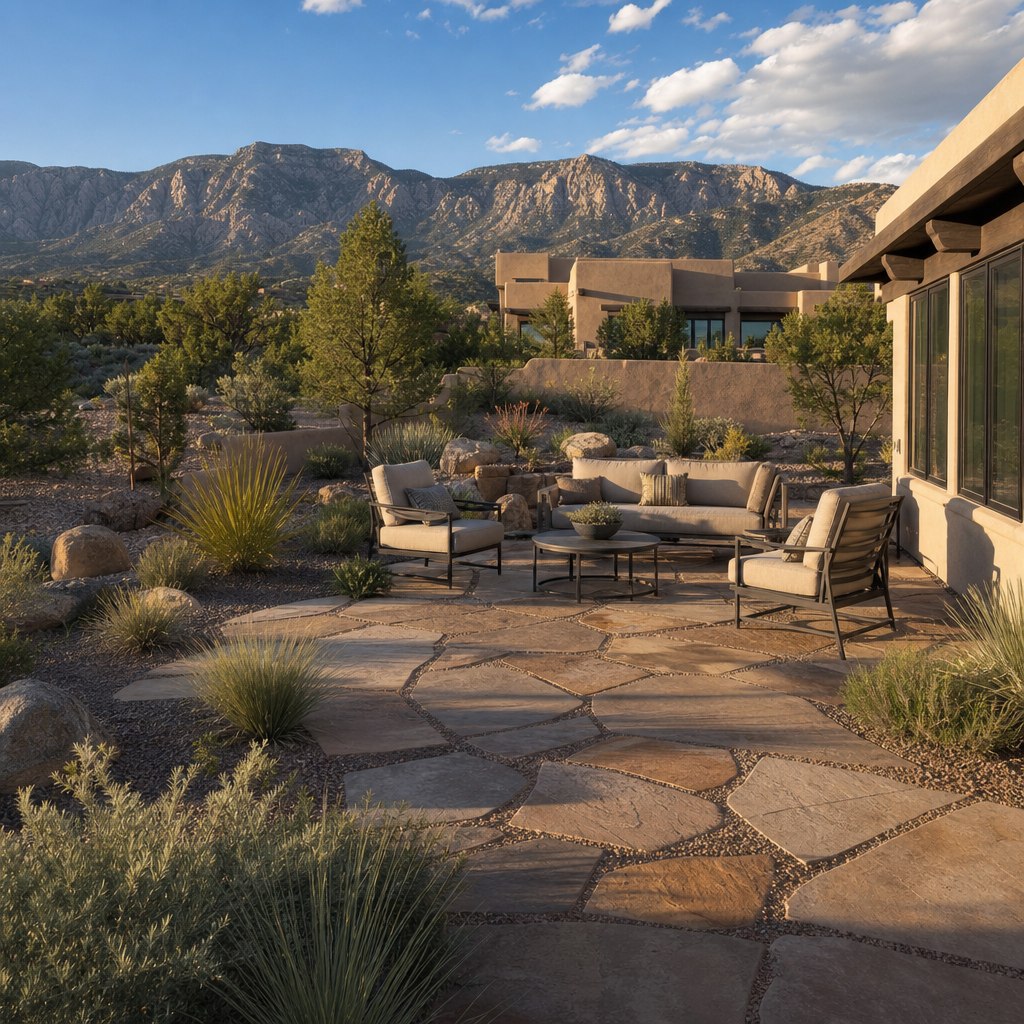
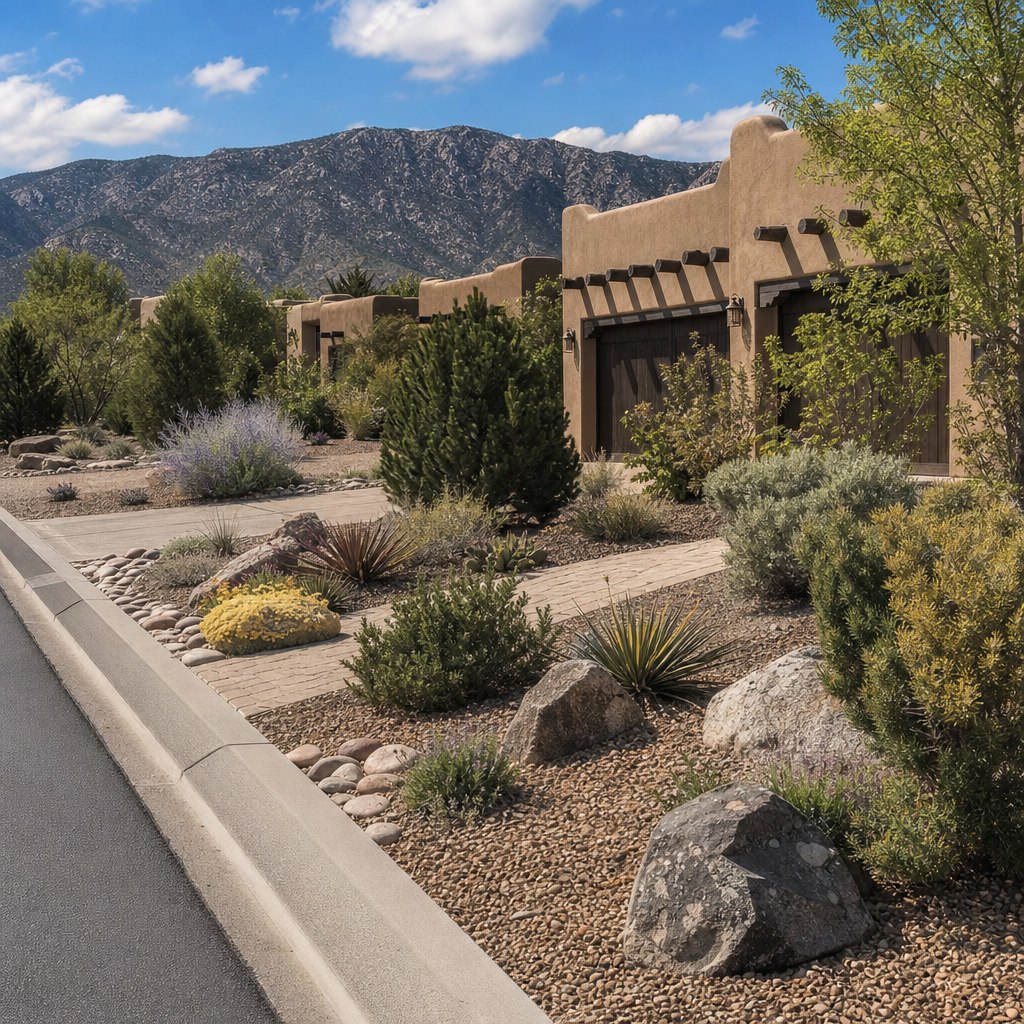
ABQ Landscape Co works across Albuquerque and Bernalillo County on both residential yards and commercial grounds. The six services below span irrigation and water management, planting and turf, tree care, hardscape and seasonal upkeep — each scoped to local water rules, soil and elevation.
Seasonal debris cleared, beds edged, weeds suppressed and everything hauled off, booked as recurring maintenance or as a one-time reset.
In northern New Mexico the cool-season seeding window runs 15 August to 15 September, so autumn clearing is scheduled to open beds before it. Source: NMSU Extension Guide H-509, Table 1.
Structural pruning, deadwood taken out, crowns thinned and growth cleared away from roofs, walls and utility lines, with all debris hauled off.
Many arid and semi-arid New Mexico soils carry cemented caliche layers beneath the surface, which limit rooting depth and shape how trees are pruned for stability. Source: NMSU Extension Guide A-151.
Base excavated, aggregate sub-base compacted, weed barrier laid, turf seamed and nail-anchored, and infill brushed to the height of the blade.
Warm-season grasses go dormant and lose color for at least five months of the year in New Mexico, which is why many Albuquerque properties choose synthetic turf for year-round appearance. Source: NMSU Extension Guide H-508.
Zone layout, emitter and head placement, pressure regulation, backflow-safe connections and controller programming, together with repair work on systems already installed.
From 1 April to 31 October Albuquerque prohibits spray irrigation between 11 a.m. and 7 p.m.; drip irrigation, low-precipitation bubblers and hand watering are exempt. Source: ABCWUA.
Planting chosen for drought tolerance, decorative rock and boulder placement, grading that handles drainage, and hardscape edging that holds a clean line.
New Mexico soils normally test between pH 6.5 and 8.4 and are typically alkaline, which drives both plant selection and any soil amendment. Source: NMSU Extension Guide A-146.
Grounds work, both maintenance and installation, for offices, retail centers, HOAs and apartment communities, timed around tenant and customer access.
Albuquerque’s 1 April to 31 October restriction on spray irrigation between 11 a.m. and 7 p.m. sets the irrigation windows commercial schedules are built around. Source: ABCWUA.
Albuquerque sits at high desert elevation. That shapes almost every planting and watering choice on a property here. Four things decide whether a yard holds up: the water rules, the grass you choose, when you plant it, and the soil underneath.
From April 1 through October 31, spray irrigation is not allowed between 11 a.m. and 7 p.m. Drip irrigation, low-precipitation bubblers, and hand watering are exempt from that window. A 30-day exemption is available to establish new sod. We design irrigation around those rules rather than around them. Source: Albuquerque Bernalillo County Water Utility Authority (ABCWUA), current guidance checked 26 July 2026.
Cool-season grasses can generally be used anywhere north of Socorro, and Albuquerque lies north of that line. Perennial ryegrass, Kentucky bluegrass, and tall fescue all work, and tall fescue is described as a good general-purpose turfgrass for New Mexico. Warm-season options are bermudagrass, buffalograss, and zoysiagrass. The trade-off is color: warm-season grasses go dormant and lose color for at least five months of the year. Source: NMSU Extension Guide H-508.
In northern New Mexico, the warm-season seeding window runs May 15 to August 1. The cool-season window runs August 15 to September 15. Sodding can be done in spring, summer, and fall. Planting outside those windows is the most common reason a new lawn fails. Source: NMSU Extension Guide H-509.
New Mexico soil pH normally falls between 6.5 and 8.4, and western soils are typically alkaline. Many arid and semi-arid New Mexico soils also carry caliche layers beneath the surface, cemented by calcium and magnesium carbonates. Caliche limits how deep roots can grow and how well water drains away. We check for it before designing beds or setting irrigation depth. Sources: NMSU Extension Guides A-146 and A-151.
Yard Cleanup & Maintenance keeps a property from sliding backwards between bigger projects. It is the recurring work: clearing what blew in, keeping bed lines sharp, staying ahead of weeds before they seed.
Desert Tree Trimming is about structure and safety, not shaping for looks. Removing dead limbs and opening a crown lets wind pass through instead of pushing against it.
Artificial Turf Installation suits properties that want green year-round without an irrigation budget. Most of the work is underneath — the excavation and the base decide whether it stays flat.
Drip Irrigation Installation puts water at the root instead of into the air. It is also the watering method the city rules leave open during the middle of the day, which makes it the practical default here.
High Desert Landscaping is the full redesign: choosing plants that belong at this elevation, placing rock and boulders, and grading so that summer storms drain away from the house rather than towards it.
Commercial Landscaping Planning works to a schedule someone else sets. The plan has to fit around tenants, customers and parking, and it has to look the same in August as it did in April.
Albuquerque project planning: Record the measured work area, existing conditions, requested materials, access limits, cleanup choice, and exclusions before comparing a property-specific written plan.
Whatever the final number is, the project scope and the price are written down and agreed with you before work starts.
Planning note 11 for property planning should connect written plan request to a measured area, a labeled photograph, or a documented owner priority. Keep any condition not yet inspected as an open item, and state the next check before it changes the written plan.
The high-desert climate means the wrong plants and the wrong watering fail fast here. Materials and irrigation are chosen to thrive locally and keep you compliant with ABCWUA watering guidelines – so your yard looks good and your water bill stays reasonable.
Call or send the form and tell us roughly what the property needs. Nothing is booked at this stage and there is no obligation to go ahead.
We walk the site and check the things that actually decide what will work: soil and drainage, existing irrigation, sun and wind exposure, and access for equipment. What we find here is what shapes the plan, not a template.
The project scope and the price are written down and agreed with you before anything starts. The number you approve is the number the job is booked at.
An Albuquerque crew carries out the agreed scope. All debris is hauled away, so the property is left usable rather than covered in green waste.
Every quote starts with a visit to the property. You should expect to come away with:
This applies whoever you hire. A written plan for landscaping work in Albuquerque should set out at least the following, so two quotes can be compared line for line:
If a quote leaves any of these out, ask for them in writing before you decide.
Albuquerque watering restrictions — currently in force
The seasonal restriction period runs 1 April to 31 October, and that period is in force now. During it, spray irrigation is not permitted between 11 a.m. and 7 p.m. Drip irrigation, low-precipitation bubblers and hand watering are exempt, and a 30-day exemption is available to establish new sod.
Source: Albuquerque Bernalillo County Water Utility Authority (ABCWUA), checked 26 July 2026. Full detail: Albuquerque Watering Guide.
We serve Albuquerque and communities across Bernalillo County:
Start with the actual work area: mark irrigation coverage, drainage paths, sun exposure, access limits and any hard ground encountered on site. That field map keeps the whole-property landscape planning scope tied to this property instead of a neighborhood assumption.
The scope should name the measured areas, preparation method, selected materials, water-zone changes, cleanup responsibility and exclusions. Any soil or irrigation condition that has not been inspected should remain an open item rather than being priced as a certainty.
A buried hard layer, uneven irrigation coverage or an unexpected drainage route can change preparation and sequencing. The property walk should identify which finding controls the next decision before materials or dates are committed.
ABQ Landscape Co works throughout Albuquerque and across Bernalillo County, including Paradise Hills, South Valley, North Valley, Sandia Heights, Placitas, Tijeras, Los Ranchos, Bernalillo, Corrales and Rio Rancho. If your property sits just outside these areas, mention it when you request a quote.
Planning note 12 for property planning should connect written plan request to a measured area, a labeled photograph, or a documented owner priority. Keep any condition not yet inspected as an open item, and state the next check before it changes the written plan.
Planning note 13 for property planning should connect written plan request to a measured area, a labeled photograph, or a documented owner priority. Keep any condition not yet inspected as an open item, and state the next check before it changes the written plan.
Albuquerque landscapers handle the work that keeps a high-desert property healthy and presentable: cleanups, mowing, tree trimming, drip irrigation planning, desert planting, hardscape scoping and design. Which of those a yard needs depends on its water setup, soil and turf. A written scope should say exactly which tasks are included.
The service pages on this site break each task down: lawn mowing, tree trimming, yard cleanup, drip irrigation planning and landscape design.
Compare written scopes line by line, not the bottom number alone. A useful quote names the area covered, what is excluded, how green waste leaves the property, and how the work follows the Water Authority’s watering rules. Two quotes that look far apart usually describe different jobs.
Our guide to choosing a landscaper lists what to compare, and the pricing guide shows how a written quote is built up.
Spray irrigation is water waste between 11 a.m. and 7 p.m. from April 1 through October 31, according to the Water Authority. Drip lines, low-precipitation bubblers and hand watering are exempt. Water that runs off a property into the street or a neighbor’s yard counts as waste at any hour.
On a residential meter under 1.5 inches the fee ladder runs warning, then $20, $50 and $100. The full set is on our watering restrictions page, read from the Water Authority’s own water waste page.
Yes, for turf conversion. The Water Authority’s xeriscape rebate pays $3.00 per square foot of turf removed, but only if its inspector pre-approves the project before any grass comes out. Half the approved area must be replanted from the plant list, with at least three inches of mulch over bare soil.
Receipts, including any contractor invoice, are checked at the final inspection, and you have six months to finish. The pricing guide walks through the numbers, and the desert landscaping page covers plant and gravel choices.
The City of Albuquerque collects residential green waste at the curb free twice a year, with the fall event listed as November 30 to December 11. Outside those events, bagged green waste is picked up for a $59.31 fee, scheduled through 311. Bags cannot weigh more than 40 pounds.
A cleanup visit can sort the debris, bag it to the City’s rules and check the irrigation zones while the ground is clear. Details are on the yard cleanup page.
Call (505) 630-1309 or send the free quote form with your address area, the part of the yard you want worked on, and a few photos. The next step is a property walk, then a written scope with inclusions and exclusions listed, so you can compare it against any other bid.
Prefer to start by phone? Call (505) 630-1309 or use the free quote page. Properties in the North Valley, Rio Rancho and Sandia Heights each have their own page.
Add the Albuquerque site conditions and the result you want reviewed.
The scope should name the measured areas, preparation method, selected materials, water-zone changes, cleanup responsibility and exclusions. Any soil or irrigation condition that has not been inspected should remain an open item rather than being priced as a certainty.