Property note 6: Selection Criteria for Artificial-Turf Planning
Artificial turf gives an Albuquerque property a consistently green, genuinely usable surface with no irrigation, no mowing, and no dormant season. In a high-desert city where spray irrigation is restricted for eight hours a day across seven months of the year, and where warm-season grasses spend a large part of the year off-colour, that combination solves several problems at once.
Property note 7: helpful landscape guide for Artificial-Turf Planning
Natural turf here involves a genuine seasonal compromise. New Mexico State University Extension guidance notes that warm-season grasses go dormant and lose colour for at least five months of the year in New Mexico — so the lower-water grass option is also the one that spends much of the year brown. Cool-season species hold colour far longer, but they are the thirstier choice, and their demand peaks exactly when the Water Utility Authority prohibits spray irrigation between 11 a.m. and 7 p.m. from April through October.
Artificial turf removes the trade-off for the specific areas where a green surface actually earns its place. It needs no irrigation, so the daytime restriction is irrelevant to it, and it looks the same in January as it does in June.
Ground conditions matter here too. Many arid and semi-arid New Mexico soils contain caliche layers beneath the surface, and caliche impedes drainage — which makes base construction and drainage design the decisive parts of any installation on an affected site.
Property note 3: helpful landscape guide for Artificial-Turf Planning
Turf failures are base failures. The visible product is the last and easiest part of the job.
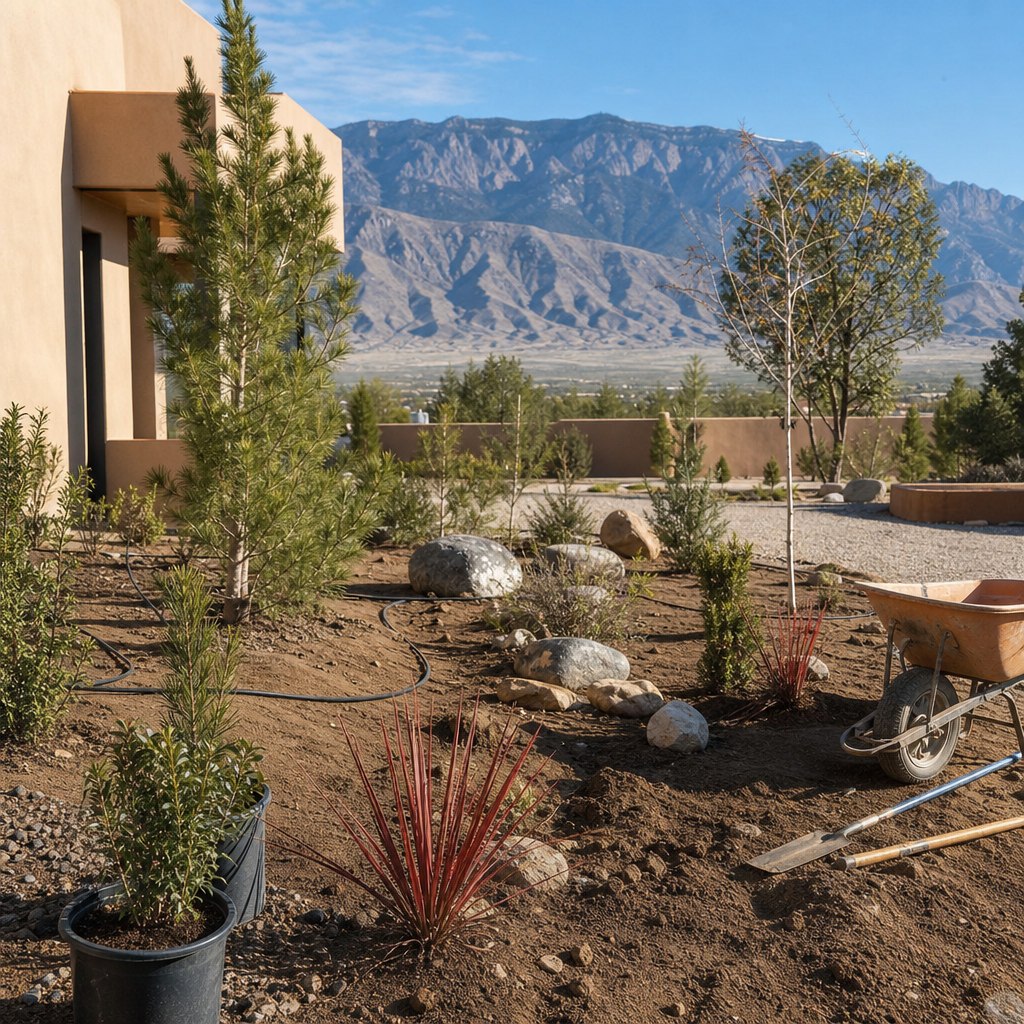
Excavation. Grass, roots, and soil are removed to a depth that leaves room for a real base. Laying turf over existing soil produces settling, dips, and drainage that fails the first time it rains hard.
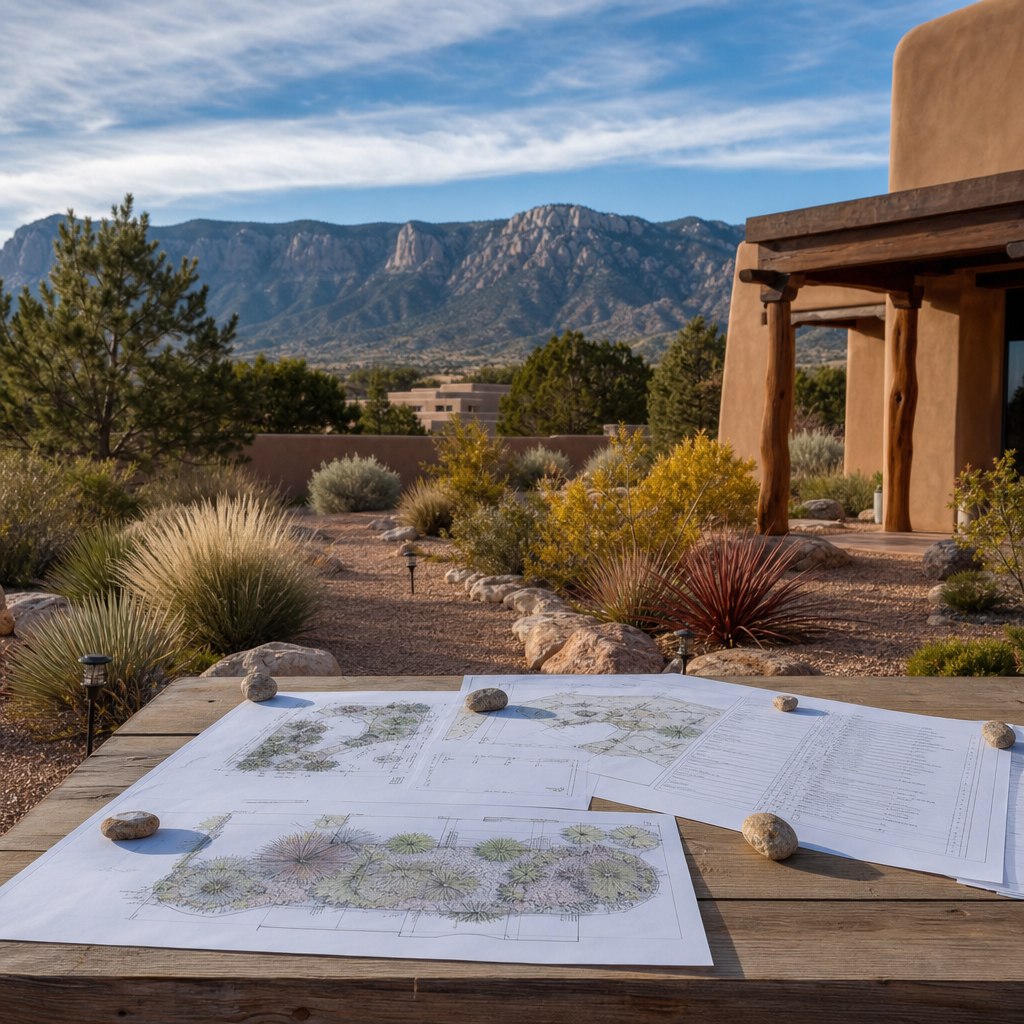
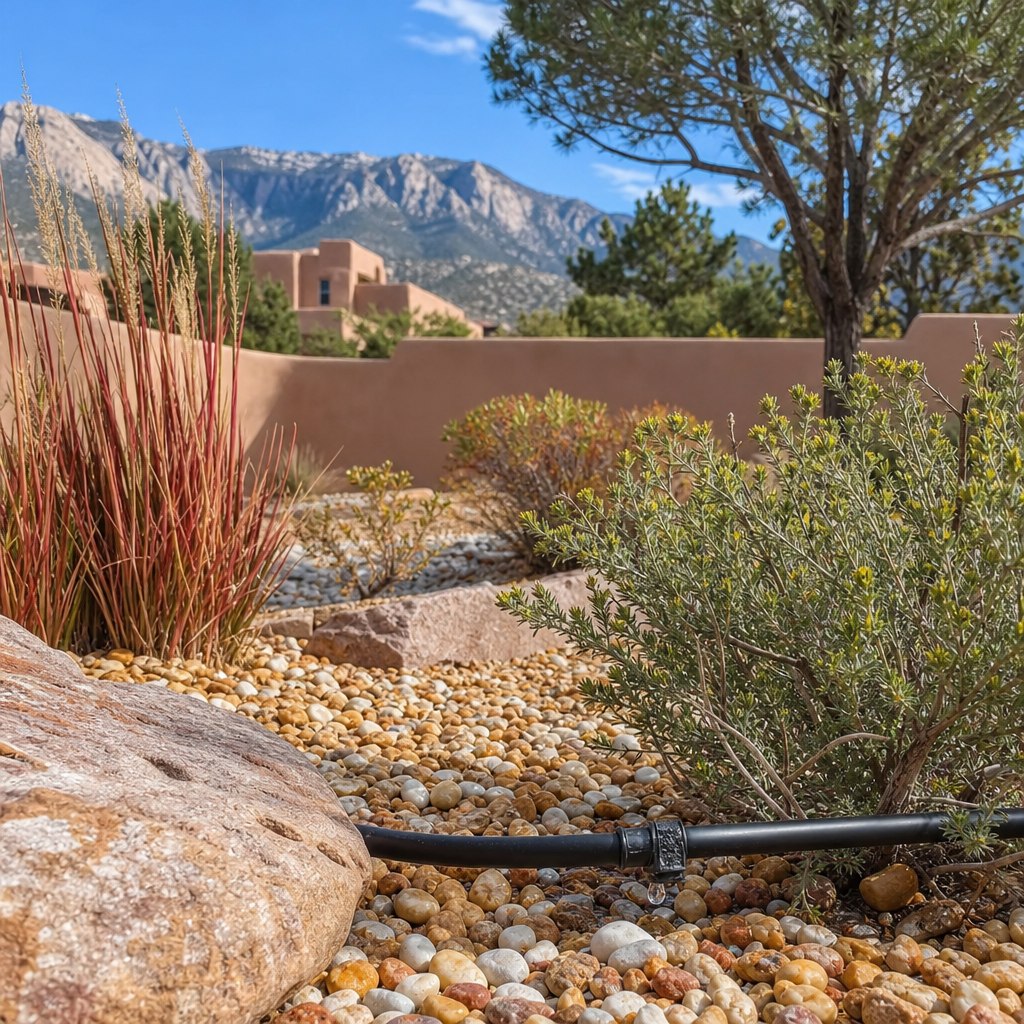
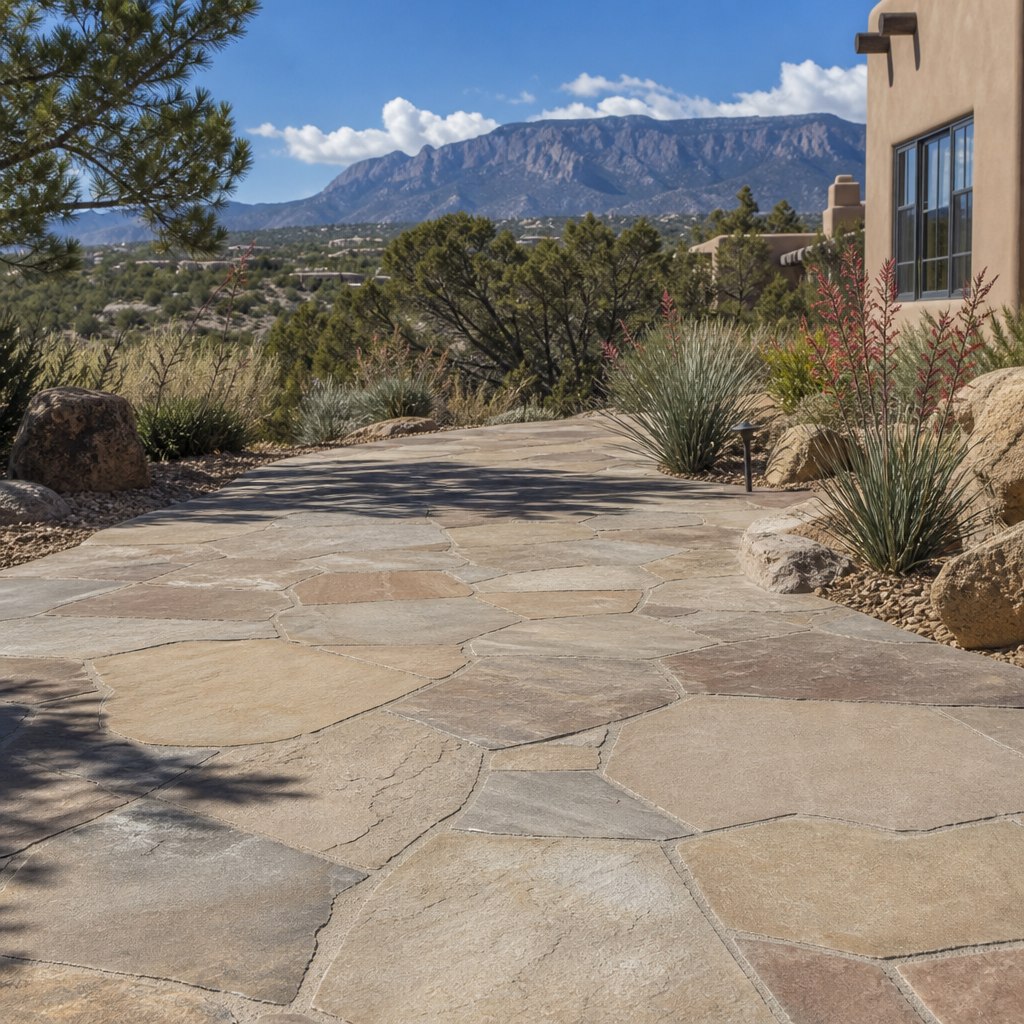
Albuquerque base specification. Before aggregate is ordered, record subgrade condition, excavation depth, finished elevation, drainage outlet, compaction method, and the treatment of any observed caliche. NMSU Extension reports that caliche layers occur in many arid and semi-arid New Mexico soils; that regional fact makes inspection necessary but does not establish that a particular yard has caliche.
Drainage — and caliche. Where a cemented layer sits close to the surface, water that passes through the base has nowhere to go unless drainage is designed for it. On those sites additional drainage is built in rather than assumed. This is the single most site-specific part of installing turf in this region.
Weed barrier. A permeable barrier over the finished base blocks growth from beneath while still passing water.
Turf, seaming, anchoring. Turf is laid with pile direction consistent across the area, seamed, and secured at every edge. Inconsistent pile direction is what makes an installation read as panels rather than lawn.
Infill. Infill is brushed in to weight the turf, keep blades upright, and protect the backing, setting how the surface feels and how well it recovers.
Property note 5: Selection Criteria for Artificial-Turf Planning
Specification should follow use. A dense, lower pile with high face weight handles heavy foot traffic and recovers well, which suits play areas and pet runs. A longer, softer pile reads more like an unmown lawn and suits ornamental areas that are viewed more than used. Pet installations need freely draining backing and an infill chosen with odour in mind. Installing an ornamental product into a high-traffic area is the most common specification error and it shows within a season.
Property note 1: Budget Inputs for Artificial-Turf Planning
Cost is driven by area, how much existing lawn or hardscape must be removed and hauled, the base preparation and drainage the site requires, the turf product and pile selected, and infill and edging. Caliche slows excavation and can add drainage work where it is shallow. Access matters, since base aggregate is heavy and every yard of it has to reach the work area. Small, awkward, heavily prepared areas cost more per square foot than large open ones. We measure and quote on site.
Timeline
Most residential installations are completed within a few days: removal and grading, then base placement and compaction, then turf, seaming, infill, and edging. Base work takes the largest share of the time and compaction cannot be rushed — time saved there returns later as settling and dips.
Property note 2: helpful landscape guide for Artificial-Turf Planning
Artificial turf is the right answer where a green surface is genuinely used and you want it without irrigation: play areas, pet runs, small front lawns, courtyards, and narrow side yards where natural grass never thrived anyway. It is a weaker answer wall-to-wall across a large property, where cost climbs steeply and a large uniform expanse can read as artificial. On most Albuquerque lots the strongest outcome pairs a defined turf area with high-desert landscaping across the remainder.
Local relevance: watering rules and the dormancy trade-off
From April 1 through October 31, the Albuquerque Bernalillo County Water Utility Authority prohibits spray irrigation between 11 a.m. and 7 p.m.; drip irrigation, low-precipitation bubblers, and hand watering are exempt, and a 30-day exemption is available for establishing new sod. Artificial turf needs no irrigation at all, so none of these provisions apply to it. It also avoids the colour trade-off inherent in natural turf here, since NMSU Extension guidance indicates warm-season grasses lose colour for at least five months of the year in New Mexico. (Sources: Albuquerque Bernalillo County Water Utility Authority; NMSU Extension Guide H-508.)
Property note 4: helpful landscape guide for Artificial-Turf Planning
Maintenance is light but real. Debris is cleared as it arrives, the pile is brushed periodically along traffic lanes to keep blades standing, and infill is topped up as it settles and migrates over the years. Pet areas benefit from periodic rinsing. Kept up routinely these are quick tasks; neglected for years, matted pile and depleted infill are what age an installation prematurely.
Frequently asked questions
Does artificial turf need watering in Albuquerque? No irrigation at all. An occasional rinse for cleanliness is the only water it sees, so the April-to-October daytime spray restriction does not apply to it.
Does it stay green all year? Yes. That is a meaningful difference here, since warm-season natural grasses lose colour for at least five months of the year in New Mexico.
Does it get hot in the sun? It warms as any surface does in direct sun at this altitude. Product and infill selection, shade, and a rinse before use manage surface temperature; shaded installations run noticeably cooler.
Will caliche cause problems? It can, because it impedes drainage. Where it is present near the surface, drainage is designed for it as part of the installation rather than discovered afterwards.
Planning an Albuquerque pet area. Start with the number and size of dogs, the route they use through the yard, the cleaning routine, and where rinse water can drain. Require the product proposal to identify backing permeability, infill, seam treatment, edge restraint, and the manufacturer?s written pet-use and maintenance instructions before selecting a system.
How long does it last? Quality turf gives many years of service. Realistic lifespan depends on the product, the traffic it carries, and whether the base beneath it was built correctly.
Sources
Albuquerque Bernalillo County Water Utility Authority — irrigation rules: abcwua.org. New Mexico State University Extension — turfgrass selection (Guide H-508) and caliche soils (Guide A-151): pubs.nmsu.edu.
Review an artificial-turf scope with Albuquerque site evidence
Get a Free Quote
Add the Albuquerque site conditions and the result you want reviewed.
Put the Albuquerque Site Conditions in Writing
Send the measured area, irrigation notes, access limits, and desired result so the proposed high-desert work can be scoped in writing.
Get a Free QuoteFrequently Asked Questions
What should be mapped before artificial-turf planning begins in Albuquerque?
Start with the actual work area: mark irrigation coverage, drainage paths, sun exposure, access limits and any hard ground encountered on site. That field map keeps the artificial-turf planning scope tied to this property instead of a neighborhood assumption.
How should the Project Plan record Albuquerque artificial-turf planning decisions?
The scope should name the measured areas, preparation method, selected materials, water-zone changes, cleanup responsibility and exclusions. Any soil or irrigation condition that has not been inspected should remain an open item rather than being priced as a certainty.
Which site finding can change an Albuquerque artificial-turf planning plan?
A buried hard layer, uneven irrigation coverage or an unexpected drainage route can change preparation and sequencing. The property walk should identify which finding controls the next decision before materials or dates are committed.